An interdimensional collective
Insectoids
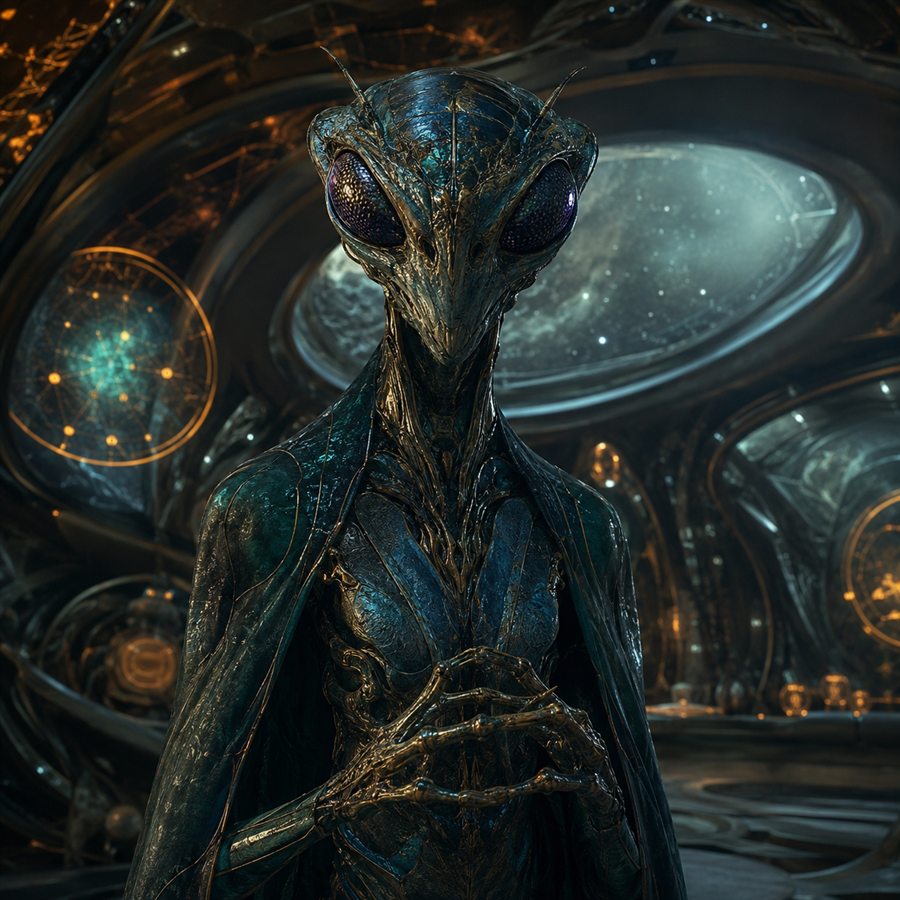
Cold order and transformationInsectoids carry the force of collective intelligence, cold order and inevitable transformation. They see the individual as part of an expansive network of consciousness.
Starseed origin and star nation
Origin, qualities, mission and contact with Earth.
- First known contact
- The 1980s–1990s – mantis encounters
- Home
- No established home planet
Opening of contact. Through the 1980s and 1990s more and more people reporting close contact began describing tall, mantis-like beings aboard craft. In 1992 David Jacobs gathered the recollections of dozens of experiencers, and insectoids recurred in them as observers who supervised the work of the Greys without intervening in it. The emotional tone of the accounts split in two: some experiencers described paralysing dread, others an exceptional gentleness. Both groups, however, said the same thing about the being's gaze. It looked at them as though it had known them a long time.
The nation's home world. Different insectoid swarms operate in the regions of Orion, Draco and Antares as well as in interdimensional collectives, and no single shared home planet has been conveyed. In their case the question of a home planet is slightly wrongly posed. Home is not a place to them but a mind one belongs to, and a swarm can change worlds without losing its home. This makes them hard to map and explains why they are recognised by manner rather than by address.
How does this nation appear? Insectoids are met aboard craft as tall mantis beings who direct procedures and supervise the work of others. Contact also opens in dreams, meditations and altered states of consciousness as telepathic images and whole systems. Experiencers almost always note the stillness. A being can stand so completely motionless for so long that one starts to mistake it for part of the room, and movement begins only when movement is required.
Its mission beside humanity. A swarm has no phrase for "in my opinion" and no word for "alone" either. From outside this looks like the disappearance of the individual, from inside like the absence of loneliness, and insectoid teaching settles exactly in between: where does the line run between belonging and vanishing? They do not draw that line on anyone's behalf. The other half of their teaching is transformation, and it is not pretty. A caterpillar does not improve itself into a butterfly; it dissolves first into something close to liquid. Insectoids soften this point not at all: nothing changes thoroughly while keeping its former shape.
How does contact open? Contact may appear as distant observation, as very rapid structures of thought or as images of the threads of a swarm mind and its interconnected points. The messages are cool, brief and systematic. No pleasantries are exchanged, because the swarm sees no content in them. The experience is often more a measurement than a meeting, and still many people describe feeling oddly calm afterwards.
How can its presence be recognised? Mantis-like figures, honeycombs, recurring grids and the merging of many minds into one are their signs. An encounter is recognised by attention moving away from oneself: your troubles do not disappear but shrink to scale. This is also where discernment belongs. Genuine insectoid contact leaves the experiencer's own boundaries intact. If the contact begins demanding that you give up your own will for the good of the swarm, it is no longer teaching but absorption, and you may end it without explanation.